



Dental Treatment Room Lighting: A Guide to Improved Ergonomics and Health in the Dental Workplace
Introduction
Dental treatment room lighting has a significant effect on the ergonomics, visual comfort and workplace health of dental professionals.
Correct dental treatment room lighting can support better posture, reduce visual fatigue and reduce eye strain. Poor lighting can make clinical work more tiring and can encourage dentists and assistants to adjust their posture to compensate for insufficient or uneven light.
For dentists, practice owners, architects and dental installers, lighting should therefore not be treated as a simple finishing detail. It is an important part of the clinical working environment.
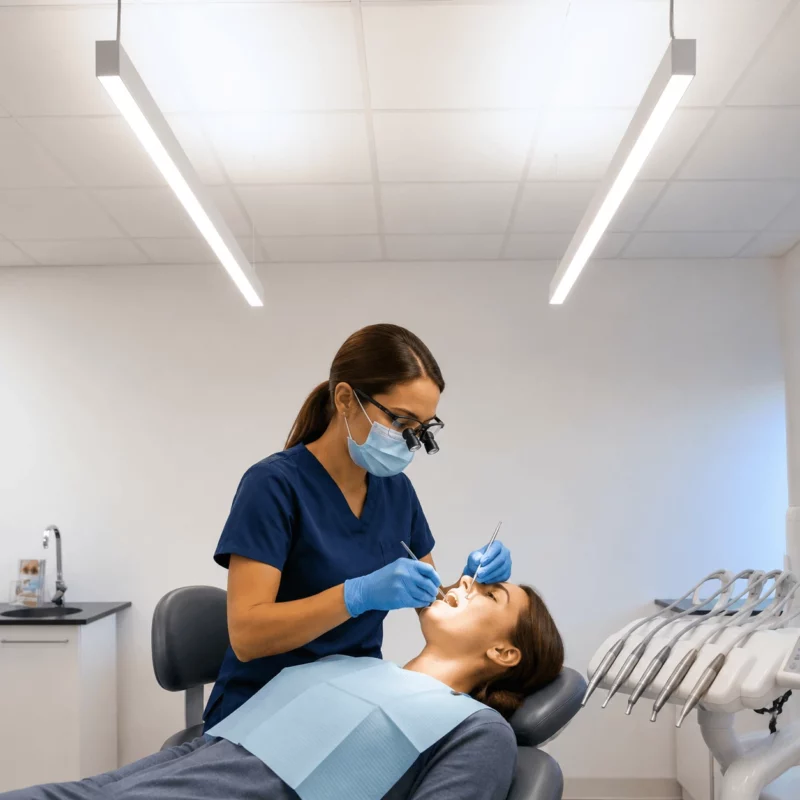
What should you consider when choosing dental treatment room lighting?
When choosing lighting for a dental treatment room, the following aspects are especially important:
- Even illumination
- Correct illumination level
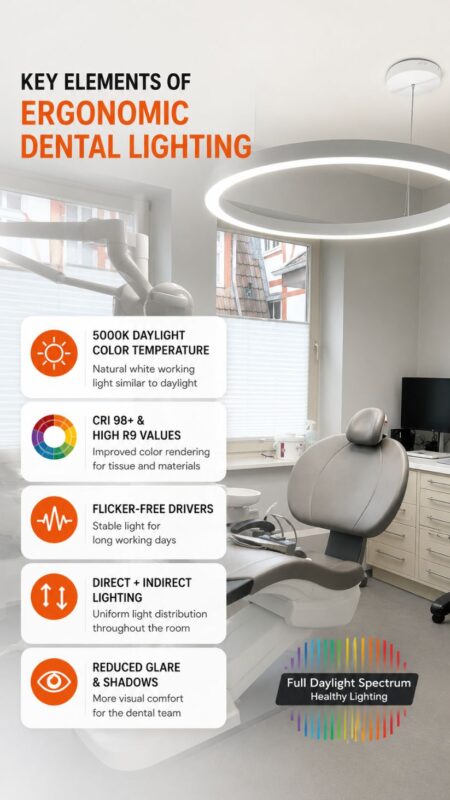
- Full daylight spectrum
- Colour rendering, CRI and R9
- Flicker-free lighting
- Ergonomics and posture
- Glare control
- Lighting in routing and surrounding areas
- The correct type of fixture for the room
- A professional lighting plan
Each of these factors contributes to correct lighting in the dental treatment room.
1. Even illumination in the dental treatment room
The goal of good dental treatment room lighting is to create a homogeneous level of light throughout the room.
Even lighting can be achieved with direct/indirect luminaires, evenly distributed LED panels or suspended fixtures that illuminate both the working area and the surrounding room. This helps prevent strong contrasts, dark corners and shadows.
The human eye adapts very effectively between light and dark. However, repeated adaptation is tiring. In a dental treatment room, the eyes constantly move between the very bright oral cavity, the instruments, the assistant zone, the screen and the surrounding room.
If the difference between these zones is too large, the eyes need to adapt continuously. This can create visual fatigue during long working days. More even illumination helps reduce this effect and improves visual comfort.
2. Correct illumination level
Correct lighting in the dental treatment room is not only about having “enough light”. It is about having the right balance between the dental operating lamp, the area around the patient’s mouth and the rest of the treatment room.
A practical guideline from Zicht op licht by Hokwerda is the ratio 10 : 1 : 0.5 between the oral cavity, the area around the mouth and the rest of the treatment room.
| Zone | Recommended light level |
|---|---|
| Oral cavity / dental operating lamp | approx. 20,000 lux |
| Direct area around the mouth | approx. 2,000 lux |
| Rest of the treatment room | approx. 800 to 1,000 lux |
This ratio helps reduce tiring eye adaptation between the bright oral cavity and a darker surrounding room.
In practical terms, this means that the area around the patient’s mouth should ideally be around 1,500 to 2,000 lux, with the surrounding treatment room at a minimum level of around 800 to 1,000 lux.
More info about full spectrum lighting? We usually reply within 2 business hours.
3. Full daylight spectrum lighting
Our visual system developed under natural daylight. Natural daylight contains a continuous spectrum of visible wavelengths. Many standard LED lamps have a more limited or uneven spectrum, meaning that they do not reproduce all colours in the same way as natural daylight.
Full daylight spectrum LED lighting is designed to mimic natural outdoor daylight more closely. This creates a more natural visual experience, improves visual comfort and supports accurate colour perception.
For dental professionals, this is important because clinical work depends heavily on detailed visual tasks. Full daylight spectrum lighting helps create a calmer and more natural working environment.
All DentLED treatment room lighting is based on full daylight spectrum LED technology.
4. Colour rendering, CRI and R9
Colour rendering is the ability of a light source to show colours accurately.
In dentistry, accurate colour perception matters for tooth shade selection, soft tissue evaluation, restorative work and communication with the dental lab. Standard LED lamps can have a lower colour rendering index, which means colours may appear less natural or less clear than they would under daylight.
Important values are:
| Value | Meaning |
|---|---|
| CRI / Ra | General colour rendering quality |
| R9 | Rendering of saturated red tones |
R9 is especially relevant in medical and dental environments because red tones are important for blood, gingiva, mucosa and skin.
DentLED lighting has a very high colour rendering value, with CRI up to approximately 98.6 and R9 above 97, depending on the specific product configuration.
5. Flicker-free dental lighting
Lighting in a dental treatment room should be flicker-free.
Many LED light sources and drivers can produce visible or invisible flicker, also known as temporal light modulation. Even when flicker is not consciously visible, it can still contribute to visual discomfort in sensitive people.
Research on temporal light modulation shows that flicker and related visual effects can contribute to visual discomfort, reduced performance, fatigue and, in sensitive people, headaches or migraine-like symptoms.
DentLED treatment room lighting uses flicker-free drivers to create calm, stable light for long working days.
6. Dental ergonomics and posture
Poor lighting can influence working posture. If the treatment room is too dark, unevenly lit or has too much shadow, dentists and assistants may unconsciously bend, twist or lean to see the working field better.
This can increase physical strain during long working days. Correct lighting supports a more neutral working posture by making the working field, instruments and surrounding area easier to see without unnecessary compensation by the body.
Good dental lighting is therefore not only a visual issue. It is also an ergonomic workplace issue.
For dental ergonomics, lighting should support the natural working position of the dentist and assistant, not force them to adapt their posture to the available light.
7. Choosing the right lighting fixture
DentLED offers different form factors for different types of treatment rooms. The design may vary, but the principle is the same: full daylight spectrum LED lighting with high visual comfort.
| Situation | Possible DentLED solution |
|---|---|
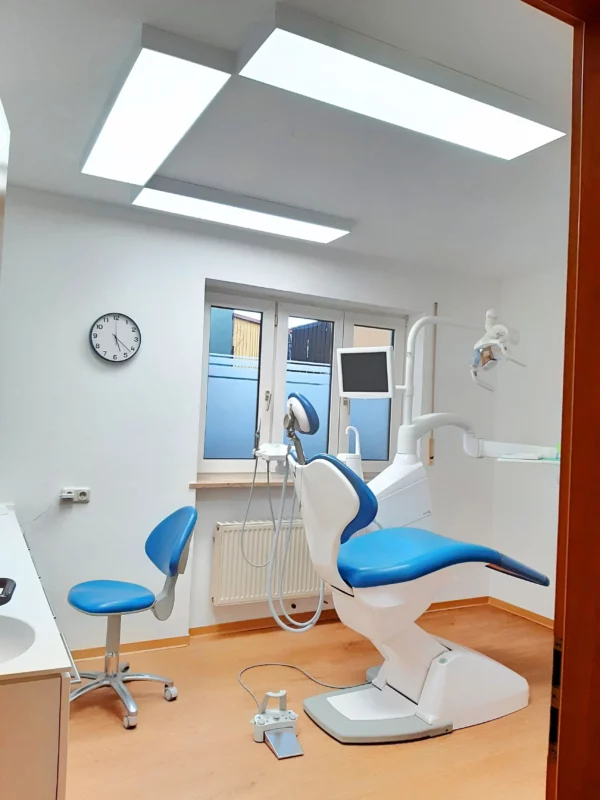
| Suspended ceiling / panel ceiling | DL60 full daylight spectrum LED panels |
| Flat ceiling | Surface-mounted LED panels with mounting frame |
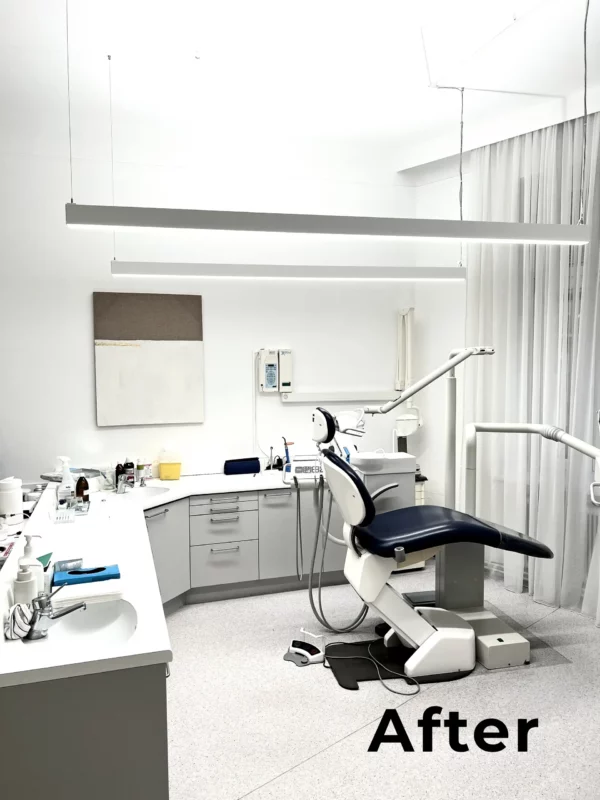
| Premium ergonomic treatment room | Suspended direct/indirect light lines |
| Design-focused treatment room | Ring-shaped or U-shaped luminaires |
| Special architecture or branding | Custom-designed lighting fixtures |
For many treatment rooms, 4 to 6 full daylight spectrum LED panels are sufficient to create the desired light level and even distribution. The exact number depends on room size, ceiling height, chair position, wall colours and ceiling type.
8. Dimming: useful or unnecessary?
DentLED rarely recommends dimming in dental treatment rooms.
The reason is simple: dental professionals should work under the correct ergonomic light level. After installation, the higher light level can take some getting used to, but in practice this is often only a short adjustment period.
Dimming may be useful in specific situations, such as consultation, patient explanation, photography or non-clinical use. For clinical work, the default setting should remain the correct working light level.
9. Routing and surrounding areas
Good lighting should not stop at the treatment room door.
Dentists and assistants move throughout the day between treatment rooms, corridors, sterilisation, storage and reception. If these areas are much darker than the treatment room, the eyes need to adapt repeatedly.
Ideally, the main routing areas used by dental professionals should also be illuminated with comfortable full spectrum lighting. This creates a calmer and more consistent visual environment throughout the practice.
10. Glare control
High light levels are only useful when glare is controlled.
Glare can occur when the light source is too bright in the field of view, when fixtures are badly positioned or when LEDs are insufficiently diffused. This can cause visual discomfort and can make concentrated clinical work more tiring.
Good glare control depends on:
- Diffuser quality
- Fixture position
- Indirect lighting
- Even distribution
- Avoiding direct view into bright LEDs
- Correct balance between task lighting and room lighting
NEN-EN 12464-1 describes lighting requirements for indoor workplaces in terms of both quantity and quality of illumination, including visual comfort, glare, colour rendering and uniformity.
11. Lighting plan and project support
A good lighting plan prevents incorrect fixture placement, insufficient light levels and unnecessary shadows.
DentLED can help create a lighting plan for renovation and new-build dental clinics. Based on experience with many dental treatment rooms, we can quickly advise on:
- Room dimensions
- Ceiling height
- Chair position
- Ceiling type
- Required lux level
- Fixture type
- Number of luminaires
- Direct/indirect lighting
- Installation requirements
- Lighting distribution throughout the room
This helps dentists, architects and installers make the right choices before installation starts.
Buyer checklist for dental treatment room lighting
Before choosing lighting for a dental treatment room, check the following:
| Question | Check |
|---|---|
| Is the room lighting evenly distributed? | ☐ |
| Is the area around the patient’s mouth approx. 1,500 to 2,000 lux? | ☐ |
| Is the rest of the treatment room approx. 800 to 1,000 lux? | ☐ |
| Is the contrast with the dental operating lamp limited? | ☐ |
| Is the lighting full daylight spectrum? | ☐ |
| Is the lighting flicker-free? | ☐ |
| Is the colour rendering very high? | ☐ |
| Is the R9 value suitable for medical and dental use? | ☐ |
| Is glare controlled? | ☐ |
| Does the lighting support good posture? | ☐ |
| Are routing areas and corridors also considered? | ☐ |
| Has a lighting plan been made? | ☐ |
Conclusion
Correct dental treatment room lighting improves more than visibility. It supports visual comfort, helps reduce eye strain, contributes to better dental ergonomics and creates a healthier working environment for the entire dental team.
For dentists and practice owners, investing in correct lighting in the dental treatment room is therefore an investment in daily comfort, clinical precision and long-term workplace health.
More information
DentLED specialises in full daylight spectrum lighting for dental treatment rooms.
We help dentists, architects and dental installers choose the right lighting solution for treatment rooms, sterilisation areas, routing zones and complete dental clinics.
Website: dentled.com
Email: info@dentled.com
Sources
- Hokwerda, O. Zicht op licht. Nederlands Tijdschrift voor Tandheelkunde.
- Zicht op licht PDF, including the practical 10 : 1 : 0.5 lighting ratio.
- CIE TN 006:2016, Visual Aspects of Time-Modulated Lighting Systems.
- NEN-EN 12464-1:2021, lighting requirements for indoor workplaces.